

Does McCartney have time to listen to 3,000 versions of Yesterday?
NewJournal+ gets a special invite as the Beatle comes to Camden Town
Our feature writer Dan Carrier was invited to hear Sir Paul McCartney talk at the Roundhouse on Wednesday evening. Here’s how fulfilling a lifetime ambition got ticked off, as Dan learned that the 84-year-old now feels able to drop the modesty and say: Yes, our music was ‘bloody great’.
THERE is a game played by people living opposite the Kentish Town Forum.
They sit on their balconies and, based on queues snaking down Highgate Road, they guess which band is playing. From teenage emos to ageing mods, scruffy metallers to pop fashionistas, those observing have told me they can call it right pretty much 99 per cent of the time.
I bet they would have struggled with the same task outside the Roundhouse in Chalk Farm on Wednesday night, as a growing queue emerged of people of every age and of all fashion tribes – and none, if men in sensible shoes counts.
It could have been a line to see the Sistine Chapel and, as acts go, Sir Paul McCartney, the Beatle, is something of a living cultural landmark.
Those gathered had come to listen to an album being played. Not a live set, but literally an album, put on a record deck and the play button being pressed. Then there was some chit-chat between each number.
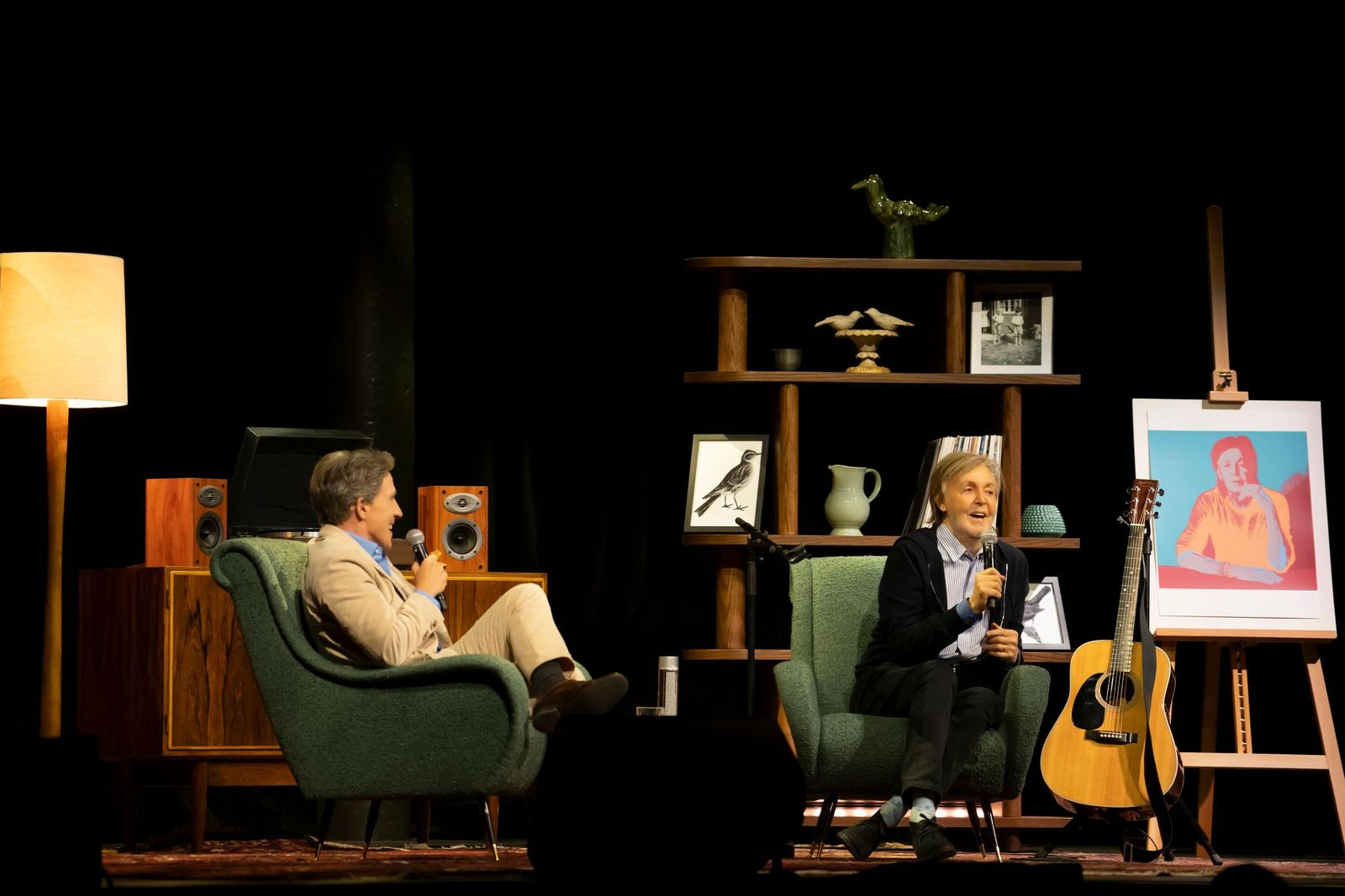
It took place on a set dressed as a comfortable, Raymond Briggs-designed English parlour — a rock and roll tea party where an audience could hear an icon make small talk.
McCartney’s new album, The Boys Of Dungeon Lane, is number one in the charts — something McCartney has got used to in his seven-decade career.
He walked on and seeing a Beatle up there in front of you is a bit of a pinch-me moment. He looks suspiciously good for 84. “I’m a vegetarian and I do pilates,” he responds when asked how he manages to keep a healthy glow about him.
But there he is. In the flesh. A real, live Beatle.
He began by saying he was pleased everyone in the room was present, and not just filming him on their phones; a side-effect of fame, he accepted with a lament.
“In my shows, when you play a Beatle song, the whole place lights up like a galaxy of stars, people holding up all their phones. Do a new song and it is like a Black Hole,” he joked in his odd, soft, trans-Atlantic Liverpudlian tone.
He revealed that being a Beatle does not mean you are overconfident when it comes to making music.
“You do something and you want people to like it,” he reflected.
“I do look at reviews. You make an album and you do it as best as you can, but you never know how people might react.”
He told the crowd the album drew on memories and nostalgia for days past, and listening to McCartney speak is a reminder of a boomer generation slipping away: those whose parents fought in the Second World War, and who were forged by the cataclysmic experience of global genocide.
This generation gave us pop music and invented the teenager, and their cultural impact has created the modern world. McCartney was a cog in it and recalled a moment in his early career. “I remember going back to our very first record, Love Me Do,” he said. “I had never heard any of our records played on the radio. I was driving in Liverpool and it came on I just went wow — we have made it! I had to pull over. It was a really special feeling.”
McCartney described how the album had been made with co-producer Andrew Watt. Watt’s studio is in the basement of his Los Angeles home, once owned by Charlie Chaplin, a point Paul enjoyed enough to mention twice.
“I met Andrew for a cup of tea and I liked him,” he said. “He had guitars everywhere. He asked me how I write songs, and I said there is no set way, no formula. What I was doing was finding quirky chords and I’d play them and that would set me in a direction.
“I would just shoot any old chord, a bizarre chord — a chord that to this day I still don’t really know what it is — maybe a D 13th flat 9th diminished flat. I put some words to it, went away from it for a while and then did some more.
“I thought — this would make a nice song. I thought I’d add some words and speak them, a little like The Stylistics.”
The opening song on the album is called As You Lie There and he explained it was prompted by a girl he had a childhood crush on.
The Beatles mined their Liverpudlian childhoods in the later part of the 1960s, with songs like Penny Lane and McCartney has returned to those themes.
“A lot of the songs on this LP are to do with memories,” he said.
“I didn’t want it to only be nostalgic, but I started thinking about images from when I was a kid. I remembered this girl called Jasmine from when I was growing up in Liverpool. I lived on a street called Forthill Road and she was a neighbour. She lived in this block of flats and I fancied her and I used to walk past and try to look up to her flat. I could see her shadow on the blinds, and I used that memory in a song.”
He admitted composing was a question of experimenting to see what direction he can go and what emerges.
“I don’t know what the trick is,” he said. “I took a class — me and George went to this school, and now it’s become a performing arts college, and I did some classes with songwriting students. It is one on one and they come in and see me and they are so nervous, it was terrible.
“The first thing I say is ‘I really have no idea how to do this’. I do not want to know about any rules for song writing and that is the fun of it.
“It is my way of relaxing. I sit down and kind of noodle around and suddenly it starts becoming something. Do I have an inkling when I have written something good? I think so. It is mainly when I have finished it and I go back. It is a special feeling.”
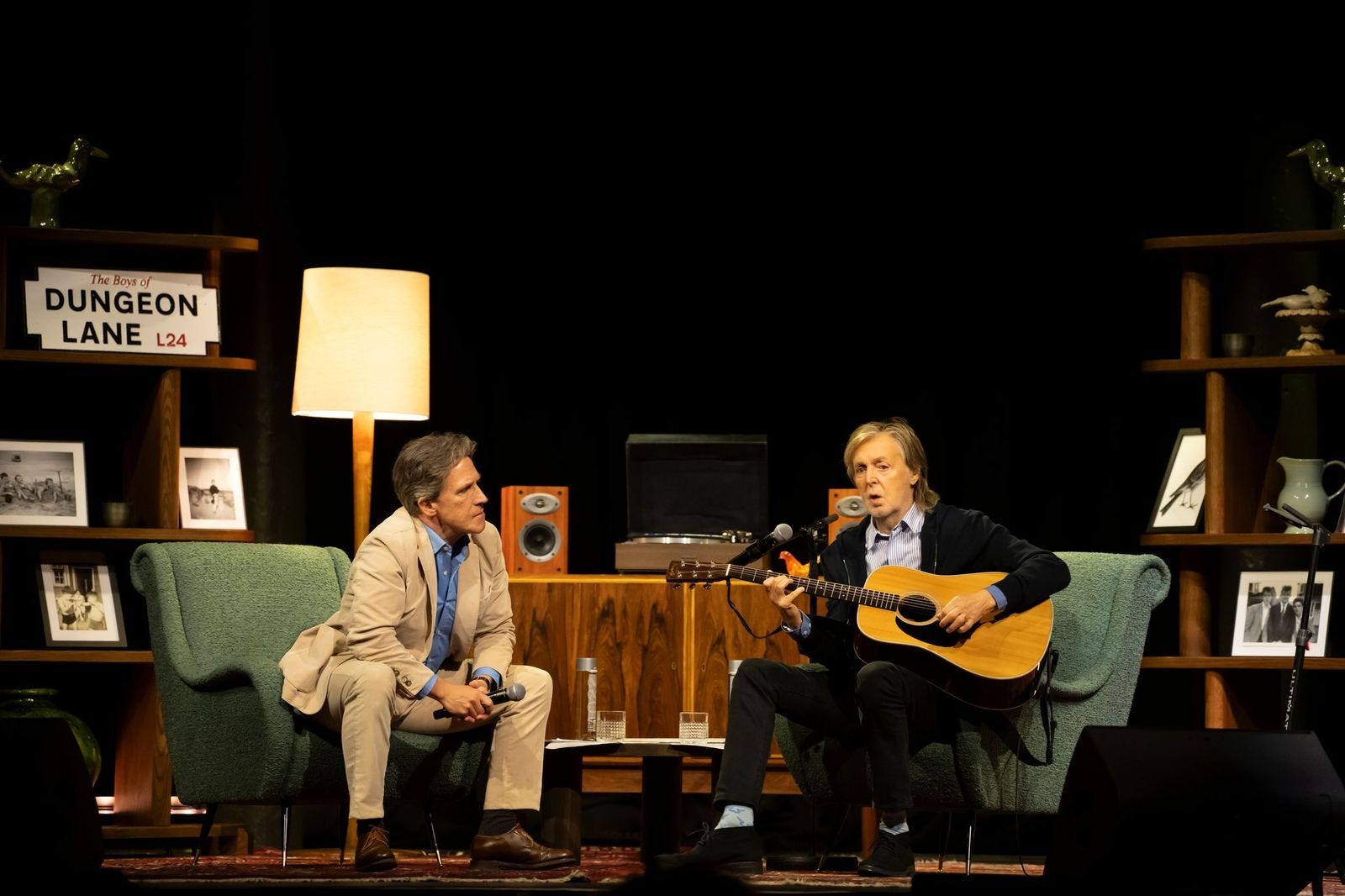
The singer said he had once asked a friend to find him 10 cover versions of his tune Yesterday to hear.
“When you write a song it is nice if someone covers it,” he said. “With Yesterday, well, a lot of people have covered that. One day a friend said to me did I know it had been covered 3,000 times? There are 3,000 versions. I lived on that fact for many years.
“I said to my friend — can you compile the top 10 for me to listen to? I mean, there is some Dutch harmonium band who has covered it — it was actually really good. Does it amaze me that it’s been covered so many times? Yes. I love that other people are doing my songs. I feel very privileged.
“Anyway, I said to my man, get me the top 10 to hear. He said there’s one by Elvis, Sinatra, Ray Charles and Marvin Gaye. The funny thing is Elvis, Sinatra and Marvin actually changed the words in the middle eight.
“It goes: I said something wrong – and they changed it to I must have said something wrong. No! I thought — you DID say something wrong.”
He said writing songs had always been about celebrating something.
“I have a hard time writing downbeat numbers,” he said.

 | A guest post by
|